
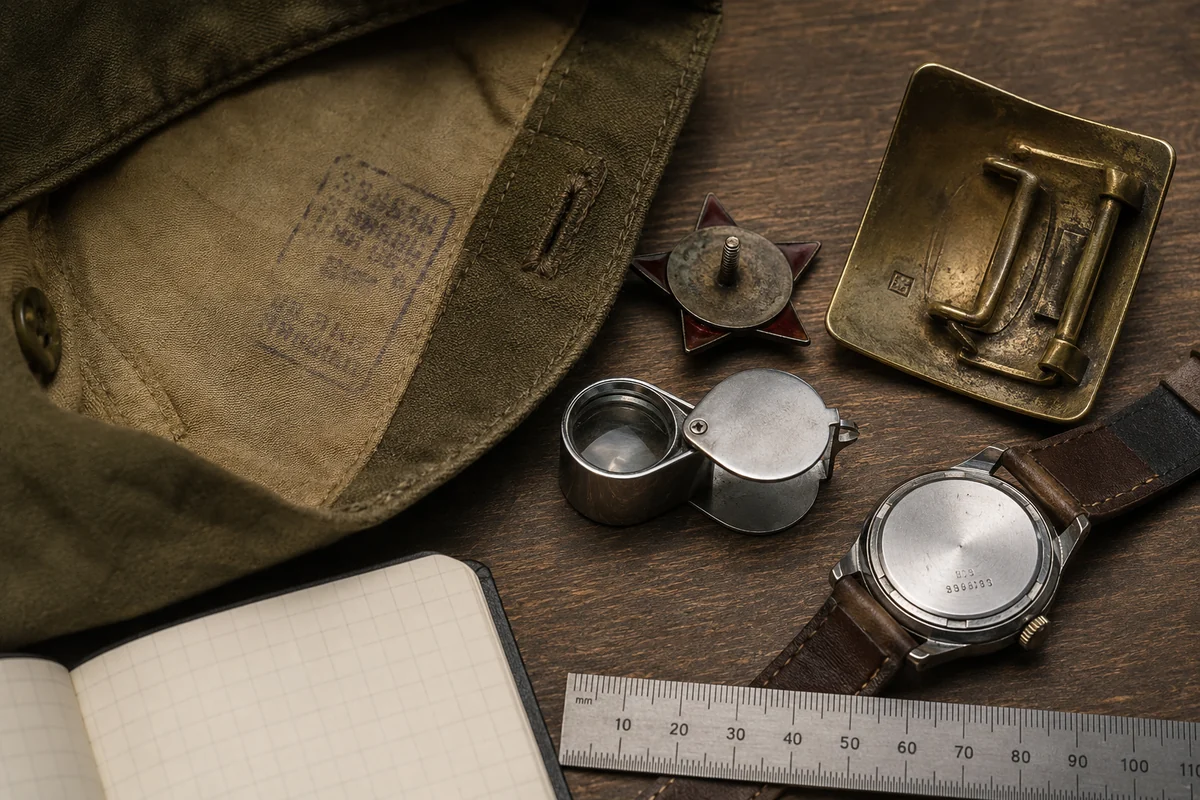
A mark narrows the field. Construction, context and provenance decide whether the identification survives scrutiny.
The seven-photo intake
- Full front or top view.
- Full reverse or interior view.
- Close-up of every label, stamp and serial area.
- Fasteners, seams, hems, hinges or screwbacks.
- Any repair, replaced part or damaged area.
- Scale photograph with a metric ruler.
- One image in neutral daylight to record color.
Read stamps in context
Record the stamp exactly as it appears, including spacing, borders and partially missing characters. A stamp placed over later stitching, printed on the wrong layer or inconsistent with the object’s wear can reveal a later alteration. Do not darken or wet a stamp to make it easier to read.
| Clue | What it may tell you | Common trap |
|---|---|---|
| Factory or workshop mark | Possible production source or institutional control | Assuming every mark is a maker mark |
| Date or year fragment | Production, inspection or inventory event | Treating an issue date as manufacture date |
| Size notation | Intended body or garment dimensions | Using a modern conversion without measuring |
| Serial area | Variant research and comparison | Believing a serial automatically proves authenticity |
Construction checklist
Compare fabric weight, weave, thread, edge finishing, fastener type, plating, enamel depth, hardware geometry and wear. No single clue is universal. What matters is whether the details agree with one another.
Reproduction and assembly clues
- Fresh synthetic thread on supposedly untouched cloth.
- Uniform patina across surfaces that wear differently.
- Modern generic fasteners behind otherwise convincing fronts.
- Artificial dirt trapped only in easy-to-reach recesses.
- Genuine insignia added to an unrelated garment.
- Perfectly matching “sets” assembled from separate objects.
Record uncertainty
Use confidence levels such as confirmed, probable, possible and unidentified. A careful “probable late Soviet” is more useful than an unsupported exact unit attribution.
Marketplace research
Use listings as research leads, not proof of authenticity. Compare construction, markings, condition and provenance.